Simplify & strengthen your brand assets: lessons from Whiskas’ packaging design
In a world where consumers are inundated with brand messages every day, creating quick, effortless brand recognition is essential. Strong brand assets that are easy to decode help your brand stand out, stay in memory and be recognised at the right moment. Whiskas’ new packaging is an example of effective brand design that aligns closely with scientific insights into marketing and packaging.

In a world where consumers are inundated with brand messages every day, creating quick, effortless brand recognition is essential. Strong brand assets that are easy to decode help your brand stand out, stay in memory and be recognised at the right moment. A recent example of effective brand design is Whiskas' new packaging, a case that aligns closely with scientific insights into marketing and packaging.
The power of simplicity in packaging design
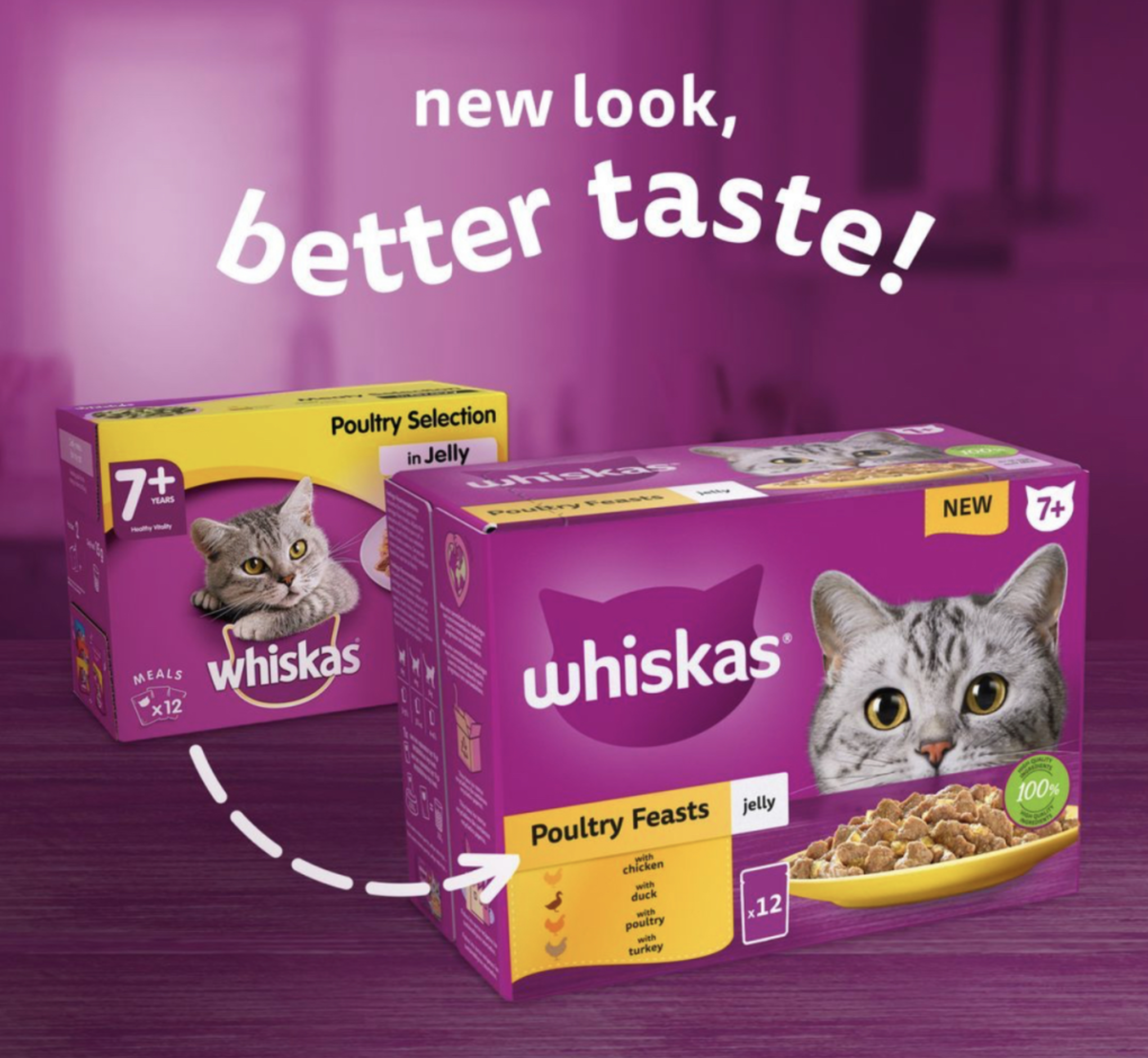
With its packaging update, Whiskas has taken an important step towards visual simplicity and stronger brand assets. Previously, multiple graphic elements competed for consumers' attention, creating visual overload. The new design is streamlined, emphasising the most important brand elements without the clutter.
Romaniuk's research shows that brands thrive through recognition and consistency rather than complexity. The Whiskas wordmark now attracts immediate attention, instantly reinforcing the brand name and its associations with cat food. This reflects the principle of perceptual fluency: the easier a brand asset is to process, the faster it is recognised and remembered (Romaniuk & Sharp, 2016).
Why this design works: eye movements and brand recognition
Our eyes naturally follow particular patterns when scanning information. In Western cultures, we read from left to right and from top to bottom. Effective packaging therefore needs a hierarchy that accommodates this natural reading direction.
The new Whiskas packaging makes effective use of this dynamic:
The Whiskas logo is prominent and acts as a visual anchor.
The cat looks towards the product, a psychological trigger that attracts consumer attention. Research shows that faces making eye contact or looking at an object direct our attention (Duchowski, 2017).
Secondary information, such as the product variant and features, sits in the corners where it is easy to locate.
The biological basis of attention-grabbing packaging
The choice of a cat with an intense gaze is deliberate. Consumer psychology studies show that we are instinctively drawn to eyes looking at us. This phenomenon, known as gaze cueing, increases a pack's visual appeal and the likelihood of consumers picking up the product (Bindemann et al., 2005).
The direction of the cat's gaze is also used intentionally. Our eyes automatically follow the gaze of others, meaning that after noticing the cat, consumers will also look at the food. This technique is frequently used in advertising for luxury products such as perfume and fashion (Wedel & Pieters, 2008).
What brand leaders can learn from Whiskas' redesign
Reduce visual clutter: fewer distractions give brand assets a better chance to establish themselves in memory.
Use consistent brand elements: as Romaniuk emphasises, brands should retain visual codes that help consumers recognise them instantly (Romaniuk, 2022).
Work with human perception: use visual techniques such as gaze direction and contrast to guide consumers subtly.
Test and measure effectiveness: eye tracking and consumer tests can reveal how people process packaging and which elements dominate.
The importance of simple, strong brand assets
Whiskas' redesign demonstrates that less can sometimes be more. Focusing on recognition, perceptual simplicity and the strategic placement of brand assets strengthens visual impact and commercial effectiveness. Any brand struggling with a complex brand architecture can learn from this: simplification and reinforcement lead to faster recognition and stronger brand preference.
Sources:
Bindemann, M., Burton, A. M., & Jenkins, R. (2005). The role of facial features in human gaze perception. Cognition, 96(1), 1-16.
Duchowski, A. T. (2017). Eye Tracking Methodology: Theory and Practice. Springer.
Romaniuk, J. (2022). Better Brand Health: Measures and Metrics to Track and Grow Your Brand. Oxford University Press.
Romaniuk, J., & Sharp, B. (2016). How Brands Grow Part 2. Oxford University Press.
Wedel, M., & Pieters, R. (2008). Visual Marketing: From Attention to Action. Psychology Press.
English version of the BrandQs archive. Historical references are preserved.