The secrets of Enduring Brands™
Most brands are built with dashboards. Enduring Brands™ are built with judgement. They understand data, but do not live inside it. They follow trends, but do not let them lead. They invest in marketing, but think in terms of value over time. This is more than a semantic distinction — it is a fundamentally different way of looking at brand building, growth and leadership. Where many organisations focus on quarterly results, Enduring Brands™ focus on lasting relevance. They build brands that withstand technological disruption, cultural shifts and economic cycles by consistently making the right strategic choices, rather than predicting everything. The fifteen principles below form a mental model rather than a checklist: a way of thinking that rarely appears in PowerPoint but recurs among brands that dominate their categories for decades.

Why some brands keep growing while others disappear — and what leaders can learn from them
Most brands are built with dashboards. Enduring Brands™ are built with judgement.
They understand data, but do not live inside it. They follow trends, but do not let them lead. They invest in marketing, but think in terms of value over time. This is more than a semantic distinction: it is a fundamentally different way of looking at brand building, growth and leadership.
Where many organisations focus on quarterly results, Enduring Brands™ focus on lasting relevance. They build brands that can withstand technological disruption, cultural shifts and economic cycles. They do this by consistently making the right strategic choices, rather than predicting everything.
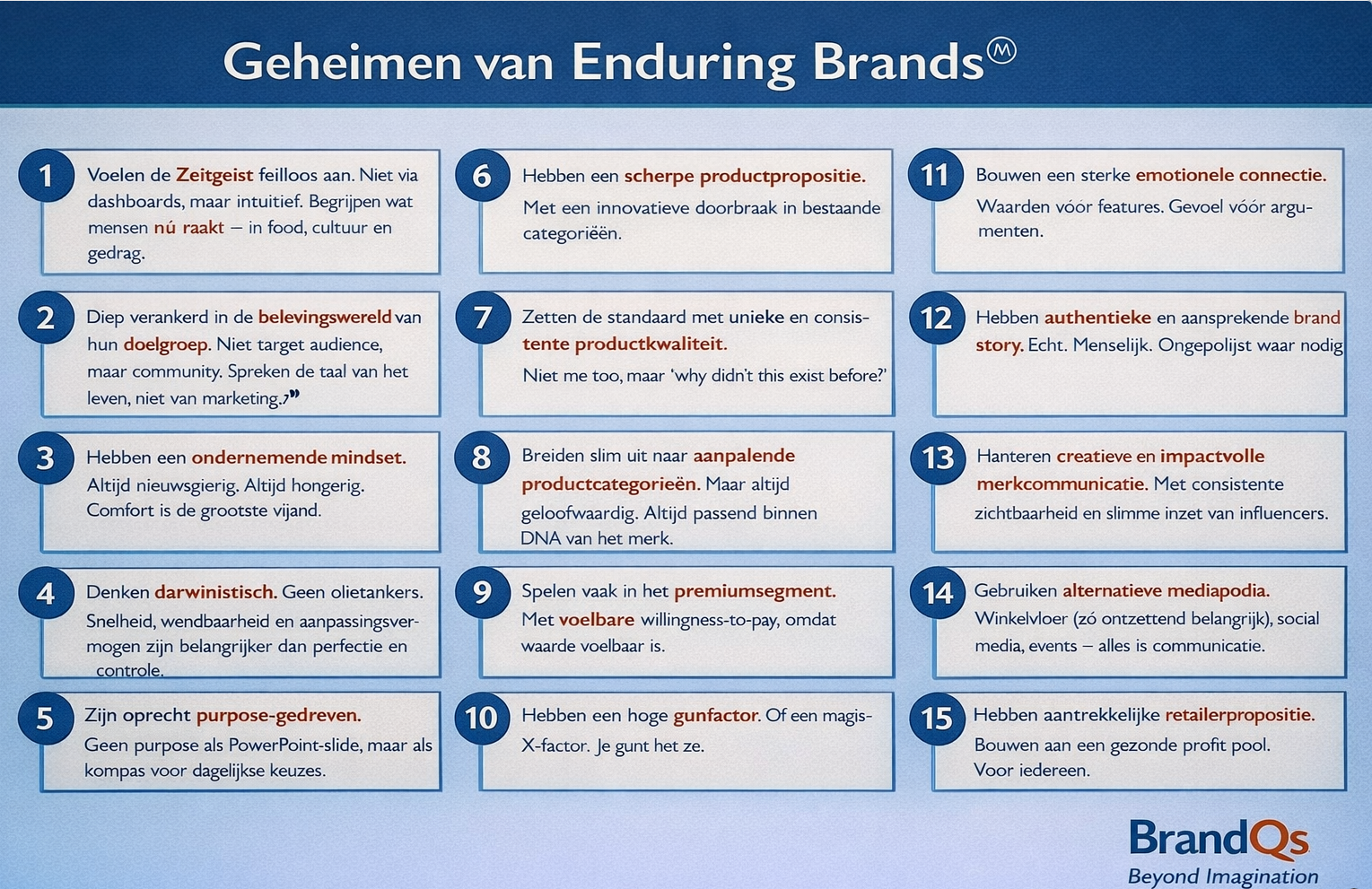
The fifteen principles below form a mental model rather than a checklist. A way of thinking that rarely appears in PowerPoint, but recurs among brands that dominate their categories for decades.
1. The zeitgeist above the dashboard
“The future belongs to those who sense before they measure.”
Enduring Brands™ have a finely tuned sense of what moves people, before it becomes visible in data. They do not ignore market research; they put it in perspective.
This closely aligns with what Harvard professor Clayton Christensen described as Jobs To Be Done: people do not buy products; they “hire” solutions to solve problems in their lives. Looking only at historical data reveals what was. Understanding the zeitgeist reveals what is coming.
Example
Oatly understood that plant-based milk was a cultural statement rather than a nutritional choice. Its breakthrough came from a sharp understanding of identity, guilt, climate and irony, rather than R&D laboratories.
➡️ The BrandQs lesson: dashboards explain. Intuition anticipates.
2. From target audience to lived experience
Speak with people, rather than about them.
Enduring Brands™ move beyond the idea of “target audiences”. They build communities rather than campaigns. This resonates strongly with Douglas Holt's Cultural Branding theory: iconic brands emerge when they identify tensions in society and give them meaning.
They speak the language of life rather than marketing.
Example
Patagonia rarely communicates about product features. It talks about responsibility, activism and boundaries. Customers feel like part of a moral compass, rather than consumers.
➡️ Brand building shifts from broadcasting to participating.
3. The entrepreneurial mindset
Curiosity as a core competence
Enduring Brands™ remain permanently hungry. They see comfort as a risk. This aligns with Reed Hastings' Netflix philosophy: “We fear complacency more than competition.”
They experiment because standing still is strategically dangerous, rather than because it is fashionable.
Example
Amazon's “Day 1 mentality” is an organisational model, not a slogan. Every decision is viewed through the lens of tomorrow rather than yesterday.
➡️ Growth comes from exploration rather than optimisation.
4. Darwinian thinking
Speed above perfection
In line with Eric Ries' Lean Startup thinking, Enduring Brands™ understand that adaptation matters more than control. They build speedboats rather than oil tankers.
Mistakes are feedback, rather than failure.
Example
Spotify launches unfinished features, observes behaviour and adjusts in real time. Its advantage lies in decisiveness, rather than technology.
➡️ In dynamic markets, the most adaptable wins rather than the strongest.
5. Purpose as a compass, not a slide
Purpose is governance, not a marketing tool.
According to Michael Porter's Shared Value theory, sustainable growth emerges when economic and societal value coincide. Enduring Brands™ understand this instinctively.
Their purpose guides everyday decisions, from sourcing to communication, and becomes credible precisely through that role.
Example
Tony's Chocolonely uses purpose as an operating framework rather than a claim. Transparency is a system there, not a promise.
➡️ Purpose without consequences is noise.
6. A clear product proposition
Differentiation is more than a creative garnish
Enduring Brands™ build what Byron Sharp calls “meaningful distinctiveness”: they are different in a way that is relevant and recognisable.
Innovation need not be spectacular — but it should make sense in hindsight.
Example
Dyson made vacuum cleaners desirable by approaching a technological problem radically differently. Not cheaper. Not prettier. Smarter.
➡️ “Why didn't this exist before?” is the ultimate validation criterion.
7. Product quality as a signal
Consistency creates trust
As Aaker describes, brand equity is built through repeated, consistent experiences. Enduring Brands™ understand that quality is an expectation rather than a USP — and precisely for that reason, a strategic weapon.
Example
Apple's strength lies in predictability rather than specifications. Every interaction confirms the same story.
➡️ Brands are believed when they do not need to explain themselves.
8. Expand intelligently, never opportunistically
Adjacency beats randomness
According to Chris Zook (Harvard), most growth strategies fail because they stray too far from the core. Enduring Brands™ expand within the logic of their DNA.
Example
Nike's expansion into apps and community platforms strengthened the brand because it extended its performance mindset, rather than simply because it was digital.
➡️ Growth is either credible or destructive.
9. Premium as a result, not an objective
Willingness to pay is emotional
Enduring Brands™ understand pricing as a psychological signal. According to behavioural economics (Kahneman, Thaler), people pay more when value is felt.
Example
Rituals sells tranquillity rather than soap. Its margin comes from meaning rather than cost structure.
➡️ Premium is perception rather than positioning.
10. The goodwill factor
The unmeasurable advantage
Some brands simply make you want them to succeed. This is no accident. It is the sum of tone, behaviour and humanity. In branding terms: emotional surplus.
Example
Innocent Drinks built affection through self-deprecation and transparency. Character rather than a trick.
➡️ People prefer buying from brands they trust over brands that are right.
11. Emotional connection above functional arguments
Brands are remembered for how they make people feel
According to Antonio Damasio, people make decisions emotionally and justify them rationally. Enduring Brands™ therefore build feeling before argument.
Example
LEGO sells possibilities rather than plastic bricks. Creativity. Time with your children. That emotional foundation makes it resilient to digital competition.
➡️ Features persuade. Emotions take root.
12. An authentic brand story
Truth rather than polish.
Enduring Brands™ tell real stories rather than perfect ones, including doubts, mistakes and evolution. This aligns with Simon Sinek's “Start With Why” but goes further: beyond why you exist to how you became who you are.
Example
Nike's communication acknowledges struggle, failure and inequality. Its story is human — and great precisely because of that.
➡️ Authenticity comes from consistency rather than control.
13. Creative, impactful brand communication
Creativity is strategy rather than decoration
According to Binet & Field (IPA Databank), emotional campaigns build more long-term brand equity than rational activation. Enduring Brands™ therefore invest in ideas that stay in people's minds, as well as converting.
Example
Volvo's safety campaigns never shout, but always hit home. They strengthen the brand even when they sell nothing.
➡️ Creativity is capital.
14. Alternative media platforms
Everything communicates
Enduring Brands™ understand that media extends beyond paid channels. The shop floor, packaging, events and service all carry meaning.
Example
Apple Stores function as temples rather than sales outlets. Retail becomes a brand experience.
➡️ Brands win in places others overlook.
15. A strong retailer proposition
Value needs to circulate
Enduring Brands™ create a healthy profit pool for every player in the chain rather than building extractive models. This aligns with Porter's value-chain thinking.
Example
Unilever's strongest brands are also its strongest retail partners, through collaboration rather than pressure.
➡️ Enduring brands think in ecosystems.
BrandQs works on Enduring Brands™, beyond individual campaigns. This means strategy before execution + meaning before visibility + judgement before automation + human intelligence strengthened by technology. We help leaders build brands that remain mentally available, culturally relevant and economically productive.
English version of the BrandQs archive. Historical references are preserved.